Guide
How many personas do you need?
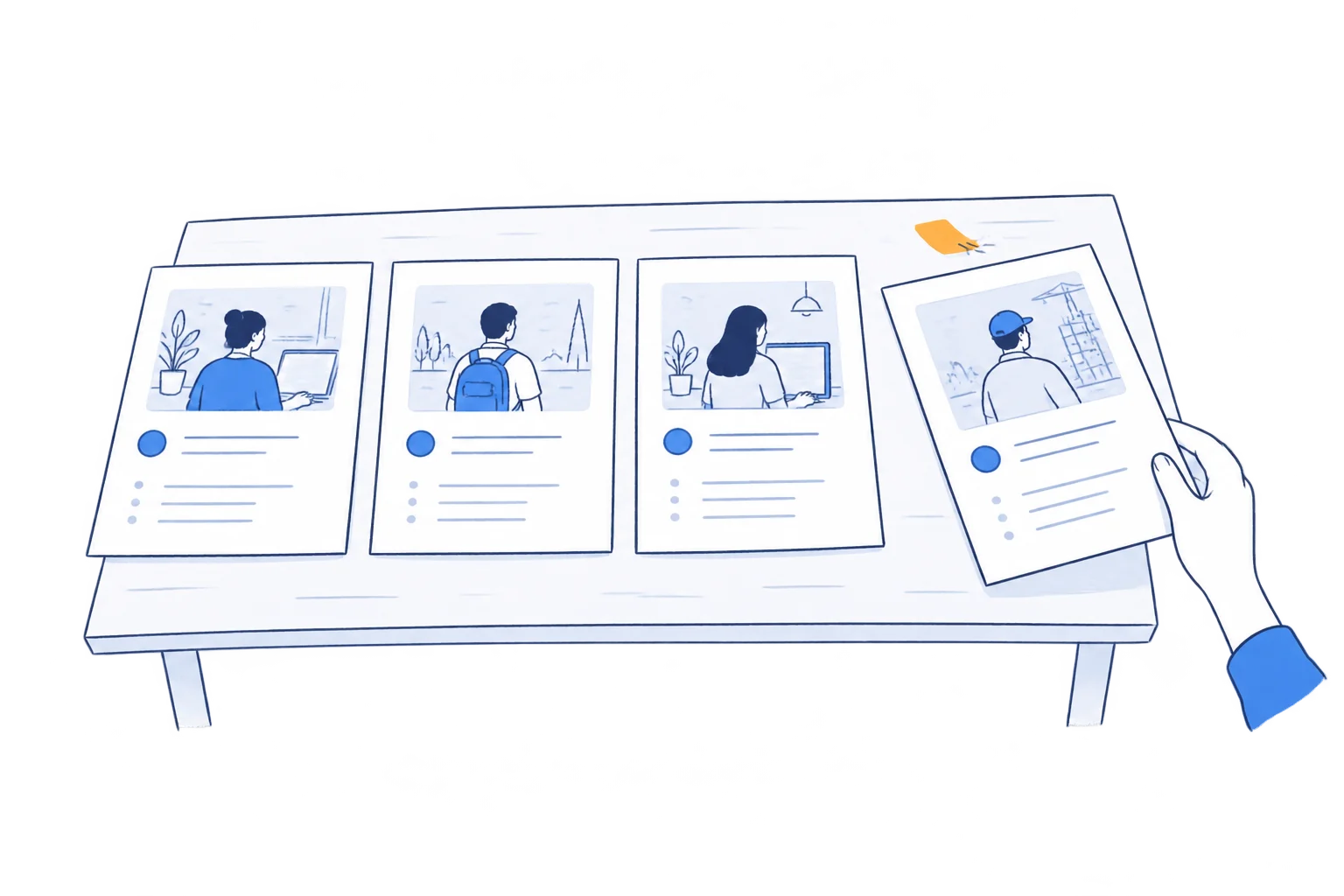
The workshop went well. There are nine personas on the wall, everyone’s favourite customer is among them, and nobody wants to be the one who takes theirs down. On Monday someone has to say which of them the team will actually design for. It might be you.
Ask four experts, get four ranges
- 3–12
- personas per design problem, by the estimate of the designer who introduced them1
- 3–6
- what Microsoft’s persona team kept to, depending on how broadly the product was used2
- 3–5
- where one proto-persona advocate stops, because beyond it the team loses focus4
- 2–6
- in the cases one leading researcher describes, each set only once the data was in5
The number comes out of the work, not into it
You may have hoped for one number to put on a slide. Nobody who has written seriously about personas will give you one, and it isn’t coyness. In one of the best-known step-by-step methods the count isn’t settled until the fourth step, after the research is in.5 When one team clustered the clicks of 2,400 users, ten distinct ways of working collapsed into five personas.6 Nobody sat in a room and chose five. Five was what the data had in it.
So “we need five personas” is the question asked the wrong way round. Start from the decisions in front of you, look for the patterns of behaviour that would change them, and let the count fall out. If you haven’t done the research yet, how to create a persona starts there.
Different jobs need different casts
What the personas are for moves the number too. A few broad personas can carry a brand’s tone of voice. Redesigning a checkout needs narrower ones, built from closer research. The sensible rule is one set per purpose.3
That’s how large organisations get away with libraries of dozens. Nobody designs for all of them at once: each project takes a small cast down from the shelf, chosen for its own work,3 with one persona in the lead.5
How to cut a long list down
List the decisions in front of you
The design and messaging calls your personas have to help with over the next few months.
Write beside each draft what it would change
Which of those decisions would come out differently because this persona exists.
Merge the ones that change the same things
Two personas that lead to the same answers are one persona with two names.
Choose the primary
The one whose needs the design must meet first, and whose needs a design for anyone else would leave unmet.
Say who you’re not designing for
Write it down as an anti-persona, so the exclusions are agreed rather than assumed.2
Somebody has to come first
If you’ve sat through the same design argument three weeks running, the trouble is rarely that someone is wrong. Each side is right about a different customer, and nobody has said which customer comes first.
The method personas grew up in settles it by giving each interface one primary persona: the one whose needs it must meet first, and whose needs a design for anyone else would leave unmet.9 Primary is a relationship, not a popularity contest. The biggest group isn’t automatically it, nor the best-paying one, and a product with three primaries is usually three products.9
The alternative has a name: the elastic user.1 “The user” stretches to fit whoever is talking, so every argument can be won and none is ever settled. Picking a primary stops the stretching. It also helps to write down who you aren’t designing for: Microsoft’s persona team kept an anti-persona for exactly that.2
Another persona doesn’t mean more customers covered
Every time someone says “but what about…?”, writing another persona feels generous. It doesn’t do what it feels like. Each persona is a narrow slice, and real customers fall between the slices. Without data on many traits at once, you can’t tell whether a persona stands for a million customers or for none.7 If you need to know how many are in each group, count them, which is what a data-driven persona does, instead of writing more.
Differences in ability show the better way. Rather than a persona for every limitation, a persona spectrum stretches one across its permanent, temporary and situational versions: one arm, an injured wrist, a new parent with a baby on one hip.11 Design for the first and you’ve designed for all three. Microsoft’s phrase for it is “solve for one, extend to many”.11
Half said their personas covered the buying committee, and few thought colleagues could name them
A complete cast that nobody can name doesn’t get used. Could your colleagues name yours? A small vendor survey: a hint, not a measurement.8
- 52.6%
- 8.2%
As the source reports it.Worked out from the source’s figures.Drawn to show the pattern, not measured.Cintell, “2016 Benchmark Study: Understanding B2B Buyers”, 137 respondents, vendor-sponsoredhttps://www.slideshare.net/slideshow/estudo-cintell-2016-understanding-b2b-buyers/63105316
Signs you’ve got the number wrong
- Two personas lead to the same decisionsToo many. Merge them.
- Nobody on the team can name them allToo many. A persona nobody remembers can’t settle anything.
- Each department has its ownToo many. They were drawn up one per team, not one per behaviour.
- Some never come up in a reviewToo many. Park them in the research notes until a decision needs them.
- Arguments end with “well, some users…”Too few. One persona is being stretched over customers who really differ.
A worked example: nine drafts, four personas
A small team runs a marketplace matching private tutors with parents. (The team is invented; the method isn’t.) Their proto-persona workshop left nine drafts: the parent facing exams in six weeks, the busy working parent, the parent planning a whole year, the parent on a tight budget, the grandparent who books for the family; and on the other side the student tutor, the retired teacher, the full-time tutor, and the tutor who wants to start an agency.
They list the decisions coming up (matching, profiles, booking, hours and payouts) and write beside each draft which it would change. The exam parent and the busy parent change the same things, so they become one. The grandparent changes exactly what the planner does; the retired teacher, what the full-time tutor does. The tight budget changes one thing every parent wants anyway, prices shown up front, so it becomes a line in both parent personas. The would-be agency changes nothing on the list yet, so it’s parked, not thrown away.
For the primaries they ask whose needs no other design would meet. Matching that works by Thursday also works for a parent with until September, so the parent who needs a tutor soon leads. A calendar that copes with a student’s hours changing every term copes easily with a career tutor’s steady week, so the student tutor leads the other side. Nine drafts, four personas, and Monday’s meeting has an answer.
Nine drafts, four personas
Questions people ask
Is one persona enough?
It can be, if the product has one kind of user and every decision in front of you concerns them. The book that made personas famous argued for designing for just one,10 and the method still gives each interface a single primary. Where the people who buy aren’t the people who use it, you need one for each.
What about business-to-business, where a whole group buys?
Map the roles in the purchase before you write anyone up: who signs, who uses it every day, who can say no. Then write a buyer persona for each role that would change a decision, and no more.
Write the one that comes first
Pick your primary persona and write it properly before the others, so the next design review has something to settle the argument with. It’s free, and you can start in your browser now.
Create a persona/persona-creator/See persona examples/personas/examples/
Sources
- Matthews, Judge and Whittaker, “How do designers and user experience professionals actually perceive and use personas?”, CHI 2012https://doi.org/10.1145/2207676.2208573Cooper’s estimate of 3 to 12 personas per design problem, and the elastic user.
- Pruitt and Grudin, “Personas: Practice and Theory”, DUX 2003https://www.microsoft.com/en-us/research/wp-content/uploads/2017/03/pruitt-grudinold.pdf3 to 6 personas, depending on the breadth of product use; one anti-persona.
- Flaherty, “Just-Right Personas: How to Choose the Scope of Your Personas”, NN/g, 2020https://www.nngroup.com/articles/persona-scope/One set per purpose; the count follows the clusters found; shared libraries of dozens.
- Gothelf, “Using Proto-Personas for Executive Alignment”, UX Magazine, 2012https://uxmag.com/articles/using-proto-personas-for-executive-alignmentConsolidate to three to five personas, beyond which focus drifts.
- Lene Nielsen, “Personas”, The Encyclopedia of Human-Computer Interaction, 2nd ed., Interaction Design Foundationhttps://ixdf.org/literature/book/the-encyclopedia-of-human-computer-interaction-2nd-ed/personasThe number set in step four; cases of two to six personas; role-based programmes.
- Zhang, Brown and Shankar, “Data-driven Personas: Constructing Archetypal Users with Clickstreams and User Telemetry”, CHI 2016https://doi.org/10.1145/2858036.2858523Clicks from 2,400 users clustered into ten workflows and five personas.
- Chapman and Milham, “The Personas’ New Clothes”, HFES 2006https://doi.org/10.1177/154193120605000503Without multivariate data, a persona may represent a million people or none.
- Cintell, “2016 Benchmark Study: Understanding B2B Buyers”, slides, 2015https://www.slideshare.net/slideshow/estudo-cintell-2016-understanding-b2b-buyers/63105316137 respondents, vendor-sponsored: 8.2% felt at least 75% of their organisation could name its personas; 52.6% covered the buying committee.
- “COMP322: Personas companion”, course notes summarising Cooper and colleagues’ About Face, 4th ed., 2014https://ihshaish.github.io/birzeit/comp322/personas_companion.htmlPrimary, secondary and other persona types, and primary as a relationship.
- Alan Cooper, “The Inmates Are Running the Asylum”, Sams, 1999https://www.informit.com/store/inmates-are-running-the-asylum-why-high-tech-products-9780672316494The sections “Design for Just One Person”, “Primary Personas” and “It’s a User Persona, Not a Buyer Persona”.
- Microsoft Design, “Inclusive 101”https://inclusive.microsoft.design/articles/inclusive-101-guidebookThe persona spectrum: permanent, temporary and situational versions of one limitation; “solve for one, extend to many”.