Persona example
A staff nurse persona for hospital software
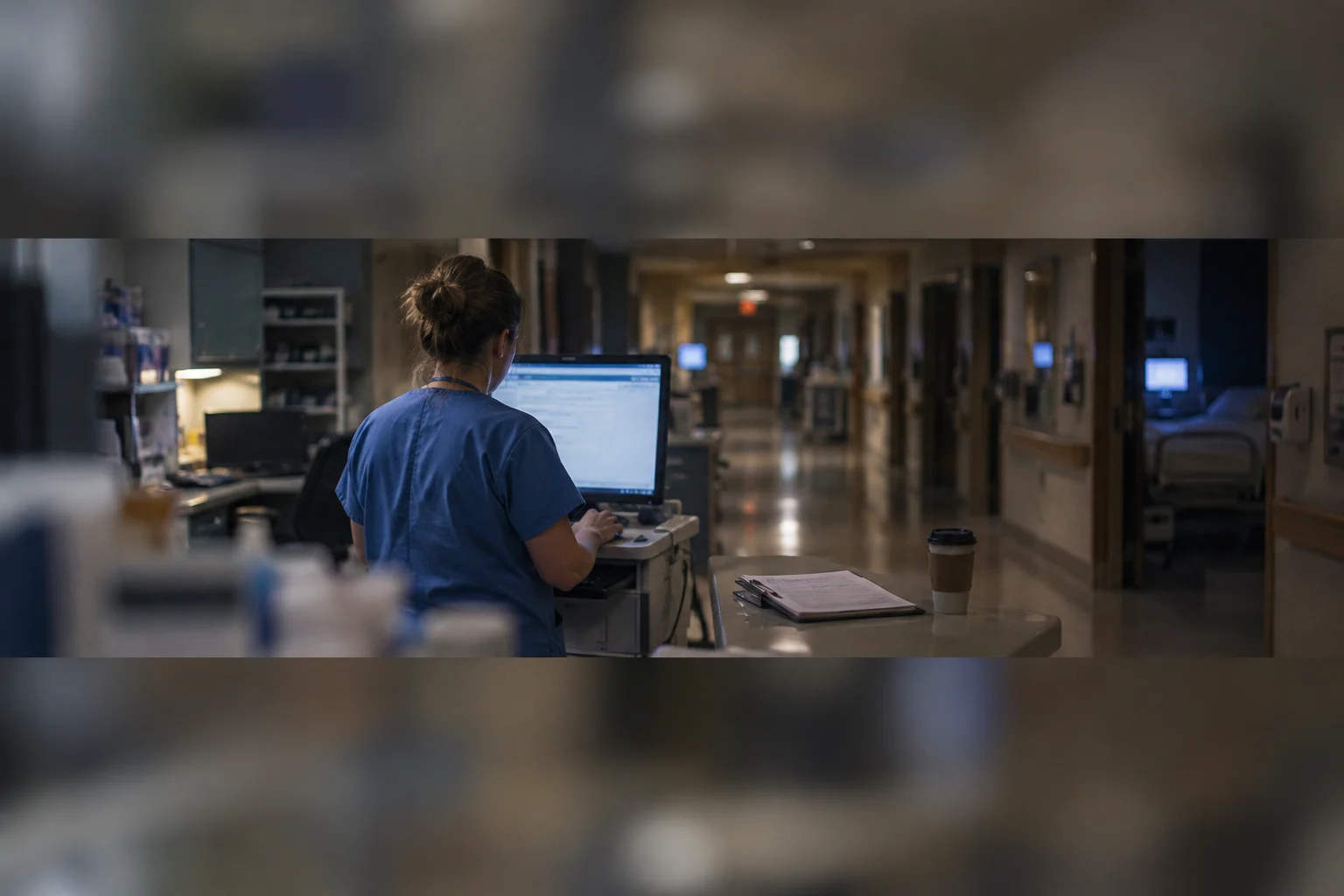
She’ll use your software standing up, gloves just off, with a call light going two doors down. Meet Erin, a staff nurse on a US hospital ward, and the shift your screen has to fit into.
UserforgeNovember 2026
The record takes a quarter of her shift
It’s 7.40 in the morning. Erin has a full assignment, two patients due for medication, one asking to go home, and a computer on wheels waiting for her to chart all of it. Morning is when nurses juggle most: on one ward that researchers watched hour by hour, nurses were doing several things at once for between a quarter and more than a third of their time, and most of all between seven and eleven.6
On that ward about a quarter of a nurse’s time went on documentation, against about a third in patient rooms.6 Every four hours brought nearly an hour inside the electronic record, reading and charting.6 It’s one ward, years ago, but nurses elsewhere say the same: more than half of hospital nurses in a large study felt the time they spent on the record was too high.4 When nurses across the US were asked to score their record system for ease of use, it came out at the level of a failing grade.5
Your product joins that queue. Whatever you ask Erin to do, she’ll do between patients, often while another nurse is asking her something. Every extra click is a minute she isn’t at a bedside.
A clumsy screen is a burnout problem
Nearly half the nurses in that large study had high burnout, and more than half described a great deal of stress.4 Most called the atmosphere on their unit chaotic or close to it, more than half said there weren’t enough nurses to care for patients, and nearly half said administration didn’t listen to their concerns.4 Health care also accounts for most of the workplace violence serious enough to cost time off work in US private industry.7
Here is what makes this your business. In a national survey of nurses, every point of better usability in their record system went with lower odds of burnout.5 Good design on a ward isn’t a nicety. It’s one of the few things software can do about the reason nurses are leaving.
She’s deciding whether to stay
One registered nurse in five changed where they worked in 2024, more than two years before,1 and four in ten hospital nurses said they’d leave their hospital within a year if they could.4 Looking further ahead, about four in ten intend to leave nursing or retire within five years.2 Stress and burnout come first among the reasons, then pay.2 Hospital nurses are more likely than clinic nurses to name burnout as why they left a job.8
Ask nurses what would help and the answer isn’t technology. They put better staffing first by a distance, and the other change most called important was a break without interruptions.4 Software can’t hire a nurse. It can stop pinging her on her break, and it can give back the minutes between patients.
There is one place where she’d welcome more help. Teaching patients and families how to cope at home is part of her job,3 yet more than half of nurses weren’t confident their patients could manage after discharge.4 A tool that makes that teaching stick would land on a worry she already carries.
Your nurses aren’t Magnet nurses in 2021
Erin is younger than registered nurses as a whole, whose median age is fifty,1 because her age sits near that of the hospital study’s nurses,4 and many of her figures were gathered during the pandemic. If yours work in clinics, care homes or outside the US, open Erin in the creator and change those lines first.
Then ask a few nurses to walk you through last night’s shift, minute by minute if they’ll let you, and ask about alarms, which we found no recent source on. Some of it touches hard shifts: go gently and let anyone pass. She’s the user persona; whoever at the hospital signs for your product needs a buyer persona of their own. Borrow more from persona interview questions.